Wollaton exterior walls
Maintaining lime render without sealing the wall
A lime-rendered wall needs maintenance that suits the complete finish and the masonry beneath it. When marks or small defects appear, the tempting answer is often a stronger coating that promises a cleaner-looking surface. Before changing the build-up, find out what is already there and what the proposed treatment would do. Routine care and compatible local repairs may be more appropriate than covering the whole elevation.

On this page
Find the specification, or establish what is known
Look for records of previous work: the render material, finish, decoration and any repairs. Product references, photographs and a dated specification can save a great deal of guesswork. If the information is incomplete, record that honestly and seek appropriate advice before choosing a treatment. The word lime in an old quotation may not describe every layer now present on the wall.
Inspect the surface from safe positions and note changes in texture, colour or hardness that may indicate different periods of work. These observations can guide an assessment, but they are not a reliable identification method on their own. A wall may contain original material, later patches and several coatings. Treating it as one uniform surface can overlook the area most likely to respond badly to a proposed cleaning or paint system.
The lime rendering guide discusses how material choice relates to traditional masonry and existing fabric. SPAB’s guidance explains the importance of compatible finishes and the potential difficulties of hard coatings on some older walls. Apply that principle to the actual building rather than assuming every old-looking surface needs the same intervention. Sound retained material can be valuable and does not need replacement simply because it is uneven.
For properties in Wollaton Village, Wollaton Park or Sutton Passeys, check the relevant conservation boundary and appraisal before an alteration to appearance. These are separate designated areas. A maintenance proposal should describe the existing finish and intended change clearly enough for the appropriate advice to address the actual work, rather than an abstract question about whether lime is allowed.
Keep the water-shedding details working
Gutters, downpipes, sills and copings influence how often particular parts of the wall become wet. Inspect accessible features from the ground and arrange competent access where necessary. A persistent mark beneath a fitting deserves investigation before the surface is cleaned or redecorated. Otherwise the same route may continue wetting the newly treated area.
Keep a simple record of recurring observations. Note the position, date and any relevant weather or recent work, with photographs from consistent viewpoints. This can help distinguish a mark that is changing from one that merely looks different under another light. It does not establish the cause, but it provides better information for an inspection than a recollection that the wall “always looks damp”.
Planting and stored items can make maintenance harder if they prevent a clear view of the wall or access to fittings. Review their position without assuming that removing all nearby vegetation is necessary. The objective is a practical arrangement in which the building can be inspected and maintained. Trellis and other supports should use an appropriate fixing detail that does not damage the render.
Avoid solving a water-related concern by sealing the surface before its cause is understood. A coating may change the wall’s appearance while leaving a defective gutter or coping untouched. Where moisture behaviour is uncertain, obtain advice suited to the traditional construction. The repair and maintenance scope should address the identified building detail as well as any damage to the finish below it.
Use cleaning trials and compatible local repairs
Choose a cleaning method with the condition and composition of the surface in mind. The relevant technical advice should address the existing finish, the deposit and nearby materials. A discreet trial helps establish whether the method changes the texture, removes material or leaves an unacceptable appearance. More force is not a reliable route to a better result on a vulnerable surface.
Allow the trial area to reach an appropriate condition before judging it. A wet patch may conceal colour variation or make the result look more dramatic than it will when dry. Keep a record of the method and outcome. If the surface responds poorly, stop and reassess rather than extending the treatment in the hope that a whole elevation will look more consistent.
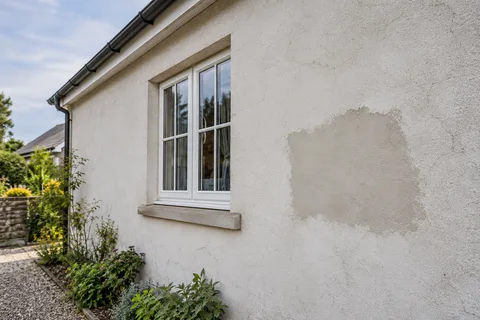
For local defects, establish the extent and choose a repair that suits the existing material and background. A small hard patch can create a different response from the surrounding softer material, so compatibility deserves more attention than immediate visual neatness. The render repair guide explains documenting the defect, selecting a workable boundary and agreeing the intended appearance.
An appropriate repair may remain visible. Weathering, aggregate and finishing technique can all affect the match. A representative sample helps establish what can realistically be achieved and whether a broader compatible finish treatment is needed. Avoid promising invisibility or repeatedly coating a small patch without considering what those layers do to the complete wall.

| Observation | Useful next step |
|---|---|
| Surface dirt or growth | Assess the deposit and test a compatible cleaning method |
| Recurring local stain | Investigate nearby water-shedding details |
| Small defective area | Assess extent and specify a compatible repair |
| Unknown paint layers | Establish coating information before adding another |
| Changed appearance proposed | Check material compatibility and relevant permissions |
Example: a sound wall with one conspicuous modern patch
Imagine an older rendered wall that remains broadly sound but has one hard, smooth repair beside a door. Painting the entire elevation might make the colour more uniform while leaving both the texture difference and the material question unresolved. The patch deserves assessment before a whole-wall treatment is chosen.
An appropriate adviser may recommend retaining, altering or replacing the patch depending on its condition, compatibility and the risk of removal. A trial can help assess the practical options where suitable. The owner can then judge a representative repair and decide whether its appearance is acceptable without assuming that every visible difference must be hidden.
This hypothetical case shows how a small defect can lead to an unnecessarily broad intervention if appearance is considered first. Keep the sound material in the assessment, establish the reason for any proposed removal and record the compatible materials finally used. Later maintenance becomes easier when the decision is understandable rather than concealed beneath another undocumented layer.
Make later decoration part of the same material decision
If decoration is proposed, identify a treatment compatible with the existing render and the intended performance of the wall. Broad descriptions such as exterior-grade or breathable do not provide enough information on their own. Ask how the proposed coating relates to the actual substrate and any earlier layers. Keep the product guidance and the reason for the selection with the maintenance record.
Colour should be assessed outdoors beside retained materials, using an appropriate sample. A subtle variation in an older wall may be part of its appearance, so decide what level of uniformity is actually wanted. A heavy coating chosen to eliminate every visual difference can change the character of the surface as well as its maintenance requirements. The sample should help make that trade-off visible before work spreads across the elevation.
Retain the dates, materials and locations of repairs and decoration. Include photographs of any exposed background and the completed work, with a short explanation of the decision. Future maintenance is easier when the next person can identify what was used and where. An undocumented sequence of modern paints and fillers makes compatible care progressively harder to plan.
The Rendering Wollaton overview links the local evidence and other finish guides, but an existing lime wall should be assessed on its own construction and condition. Keep routine maintenance modest where that is appropriate, obtain specialist advice for uncertain defects, and make any change to the build-up a deliberate decision. The wall’s long-term care is more important than achieving a briefly uniform photograph.
See housing and planning information for Wollaton and nearby places, including the source and geography behind each figure.